



























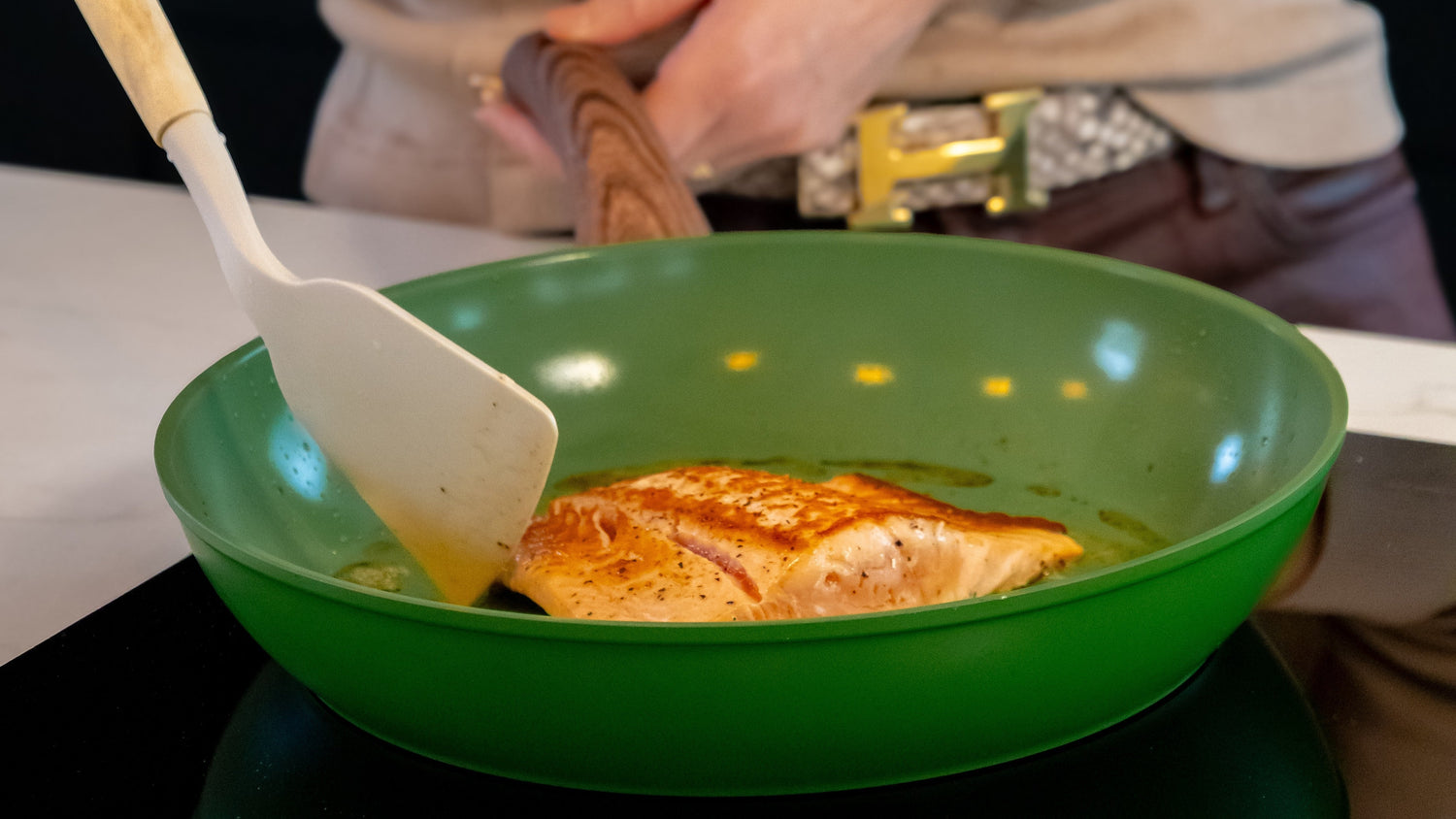
A pan often still looks fine on the outside, but the story inside can be very different. Discoloured patches, tiny scratches, a strange smell when it heats up: each one a signal that the coating may no longer be doing what it should. And in the worst case, substances are leaching out that you'd rather not have in your food. Time to take a critical look at your pans.
Why the coating matters so much
The non-stick layer is more than a handy way to release a fried egg. It's the barrier between your food and the pan's base material. With a healthy coating, nothing special happens: cook, rinse, done. With a damaged or wrongly composed coating, tiny particles can come loose and end up in your food. Not always immediately dangerous, but over years you're picking up a lot of unnecessary junk. And some coatings of the past contain substances we now know shouldn't be anywhere at all.
PFAS, PFOA and the old generation of teflon
The biggest culprits sit in the PFAS family: per- and polyfluoroalkyl substances. PFOA was the standard for non-stick coatings for a long time, until research showed it accumulates in the body and the environment. Since 2015, PFOA has been banned in Europe. Other PFAS variants have only recently been more strictly regulated, and some haven't even appeared on regulators' radar yet. If you have a pan from one of those eras and don't know what's in it, caution is in order.

Signal 1: peeling, flaking or black bits
The clearest sign: do you see dark flakes in your food, or does the surface feel rough where it should be smooth? Then the coating is coming off. With a traditional PFAS layer, this means you eat little pieces of coating every time you cook. With ceramic coatings, loose particles are less harmful, but the pan loses its non-stick performance. In both cases: replace it.
Signal 2: discolouration and stains that won't go away
Brown or yellowish stains you can't remove despite proper cleaning often point to baked-in fats and overheating. That chemically attacks the coating. Combine that with a pan that releases worse than before, and the coating is degrading. When in doubt: smell it after heating. A faint chemical smell is a red flag.
Signal 3: scratches, pits and visible base metal
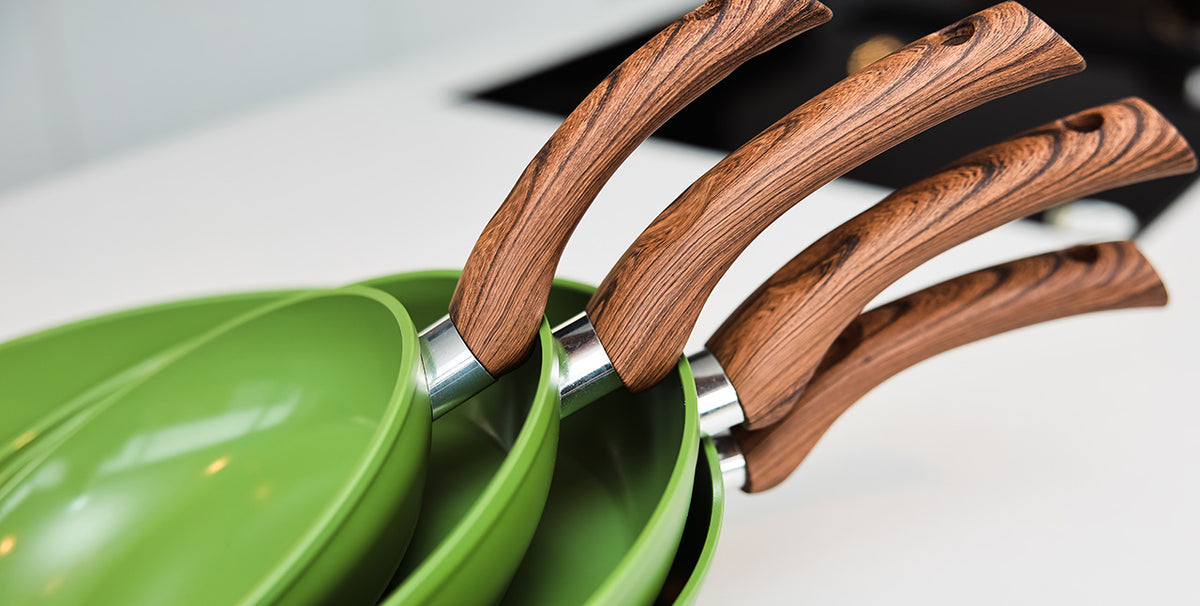
Scratches aren't always the end, but they are a warning. As soon as you can see the base metal on bare patches, the coating has been breached. From that point on, hot food comes into direct contact with aluminium or steel, and the surrounding coating can flake off faster. Stop using this pan for acidic or sticky dishes. To avoid scratches in a new pan, it always helps to care for it properly with wooden or silicone utensils.
Signal 4: a vague or chemical smell when heating
A new pan may give off a slight smell on first heating thanks to manufacturing residues. That's normal and gone after one use. Does a pan you've used for months or years suddenly give off a sharp, chemical odour? Then something is wrong. The coating no longer holds and may release compounds you'd rather not breathe in or eat. Ventilate well and set the pan aside.
Signal 5: the pan suddenly sticks, or sticks to everything
A healthy non-stick pan barely needs any fat. Do you notice that even an egg suddenly sticks, even though nothing has changed in your cooking? Or do you have to use more and more oil for the same result? Then the coating is worn out. With a PFAS pan, this is often also the moment it starts degrading at a microscopic level. Our ceramic frying pans are designed to keep their non-stick performance for years, as long as you don't overheat them.
Signal 6: bought before 2015 and no PFOA-free stamp
Do you have a pan that's older than ten years and you can't find any mention of PFOA-free or PFAS-free? Big chance there are still substances in it that are now banned for new production. A pan like that can still work, but every crack or scratch releases more. With cooking on medium-high heat and no damage, the risk is limited, but as soon as the coating shows signs of wear: replace it.
Signal 7: a brand without transparent specifications
A trustworthy pan tells you exactly what's in it on the packaging or product page. Coating, base material, induction-ready or not, with or without PFAS. Find nothing and the manufacturer is untraceable? Then be extra alert. Especially with cheap no-name pans from large marketplaces, the chance is high that they contain coatings that are no longer allowed in Europe. Our entire ceramic saute pan collection has full specifications on every page.
What to do with a suspect pan
- Take it out of the daily rotation and stop using it for acidic foods like tomato sauce or lemon marinades
- Don't heat it on the highest flame anymore, not even briefly
- Use it at most for dry warming or non-edible purposes
- If clearly damaged and of unknown origin: dispose of it at a metal recycling point
- Get a replacement with clear, PFAS-free specifications
How to keep a new pan from quickly becoming a suspect case
Coatings, even the safe ones, have a finite lifespan. How you treat the pan largely determines how long it lasts. A few habits that make the difference:
- Never heat an empty pan on the highest setting. Medium-high is almost always enough, especially with ceramic
- Don't use cooking sprays. They leave a sticky film that won't come off and accelerates wear of the coating
- Always let a hot pan cool down before rinsing it. Thermal shock causes microcracks
- Wash by hand with a soft sponge. Dishwashers, especially with all-in-one tabs, wear any coating faster than handwashing
- Don't stack pans without protectors between them, that scratches the inside
Want to dive deeper into why ceramic holds the better hand here? Read why ceramic is the smart choice.
The difference between ceramic and traditional coatings
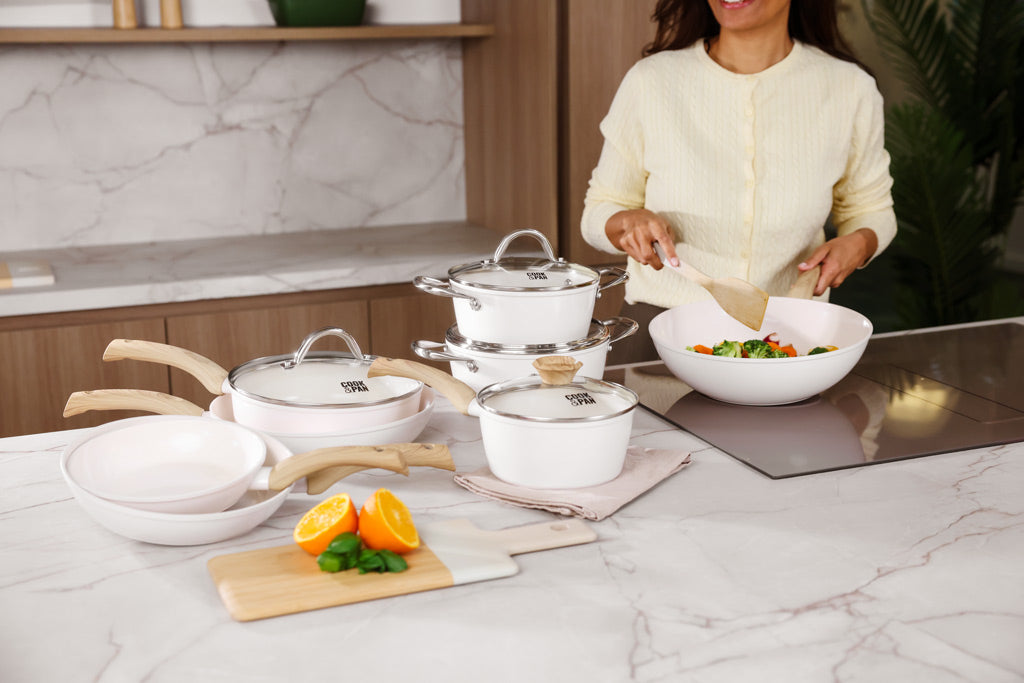
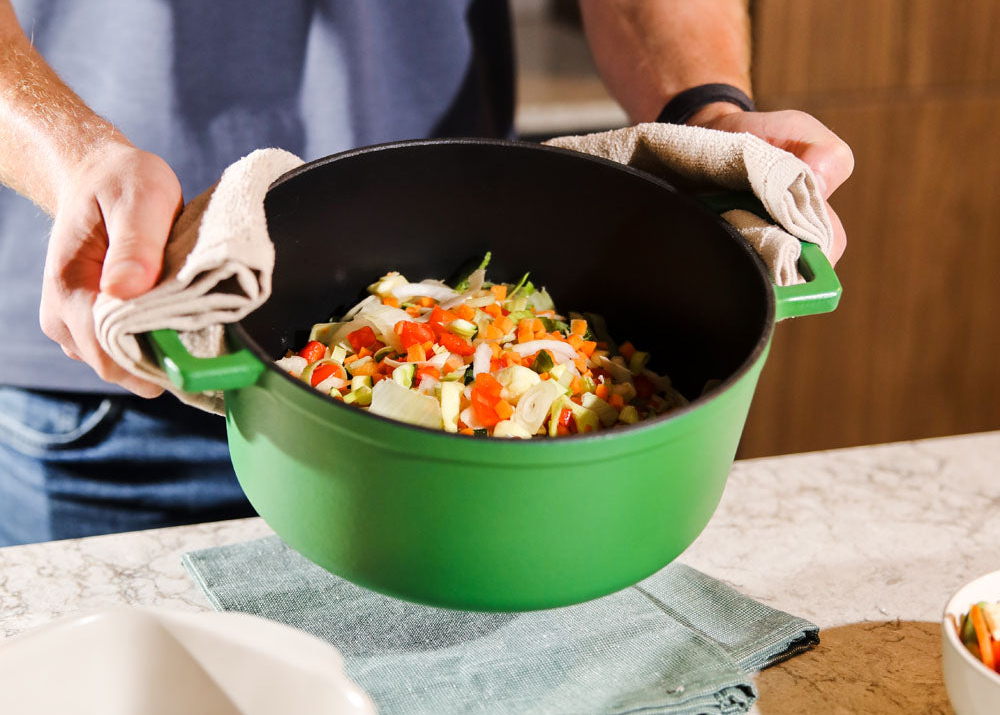
Ceramic coatings are built from silicon oxide, a naturally occurring mineral. No PFAS, no PFOA, no synthetic polymers that can off-gas at high temperatures. When damaged, the base material is in most cases simply sandy and not harmful. Traditional teflon coatings are synthetic polymers that can degrade at temperatures above 260 degrees, and that does release compounds you don't want. For anyone who braises or stews, a cast iron or ceramic casserole pan is a far safer alternative.
The role of the base material
Coating and base belong together. A thin aluminium pan with a top coating still gives trouble if it warps and the coating lifts. A well-weighted aluminium or stainless steel base with a properly applied ceramic coating lasts for years. Induction asks more: a ferromagnetic bottom, even heat distribution, and a coating that handles heat without degrading. For a wok pan on induction this is extra critical because you often work at high temperatures, so check our ceramic wok pan.
Replace or carry on: an honest call
Not every old pan needs to go straight away. Do you have a pan with no damage, bought after 2015, with a clear PFAS-free mention and that still releases nicely? Keep using it, as long as you stick to the basic rules. Doubt about one of the signals above? Then replacing is more than worth the effort. For a complete kitchen refresh, or for anyone starting their first own set, a frying pan set is the logical step. And if you mainly braise or are after a serious stew pot, first read the five questions before buying a casserole pan.
Bonus: oven and coating
Many people forget that oven safety isn't just about the handle. The coating has to handle the heat too. A PFAS pan in an oven at 220 degrees isn't a problem, but at a high grill setting you're quickly past the tipping point. Want to know which pans you can safely slide into the oven? Have a look at tips for ovenproof pans.
Summary: your pan check in five minutes
Walk through your cupboard and ask yourself the following questions for each pan. Three or more yeses: time to replace.
- Do I see blisters, splinters or dark flakes?
- Are there scratches where the base metal shines through?
- Does food suddenly stick, even with enough fat?
- Does the pan give off a chemical smell when heated?
- Is the pan older than 2015 with no PFOA-free mention?
- Don't I know which coating is on it?
A safe kitchen starts with knowing what's in your pans. Cook & Pan is fully transparent about coating and materials, precisely so you never have to wonder whether that non-stick layer is up to scratch.
💡 Please note: we love cooking with boldness, but safety always comes first. Read more on our disclaimer page.