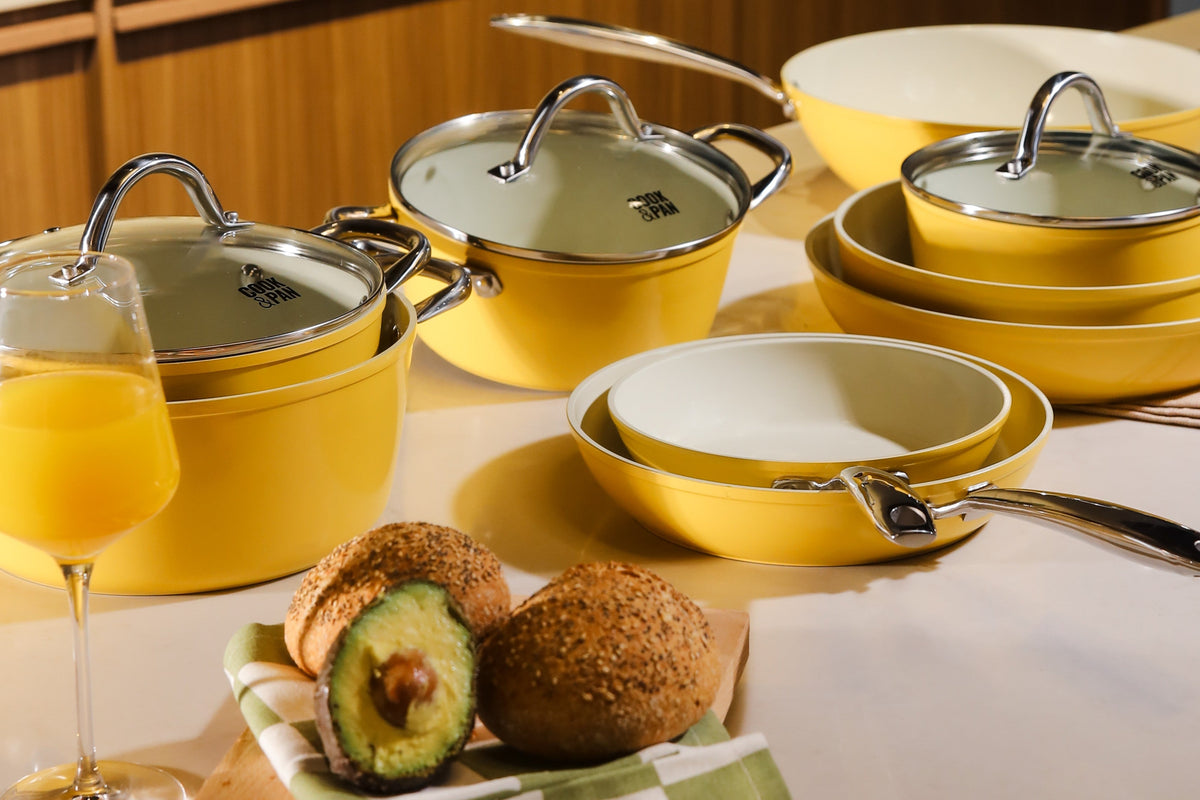

















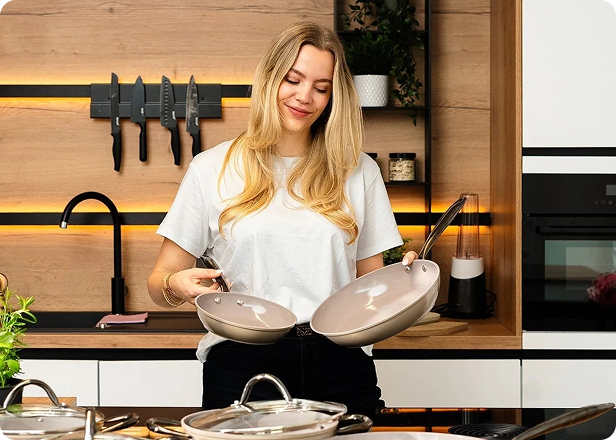

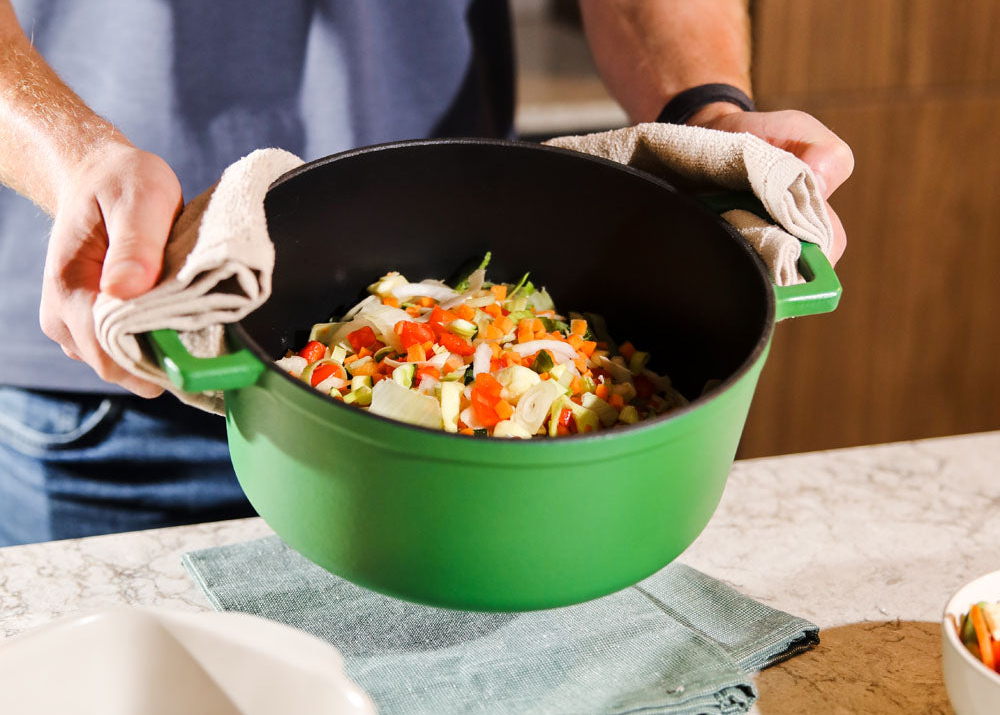








You stand in front of the shelf or scroll through a webshop, see a nice pan at a friendly price and think: this is the one. Three months later everything sticks, the coating is flaking onto your fried egg, and you regret it. A bad pan purchase happens faster than you think, but there are clear signals you can watch for in advance. No sales pitch, no marketing magic, just the facts on how to spot a pan that lasts for years.
Buying a pan looks easy, but it isn't
Pans look alike. Round, non-stick coating, handle, done. Under that uniform surface lies a world of difference: base thickness, coating type, material quality, production process, factory standards. One pan is still your favourite after fifteen years, another is rubbish after six months. The devil is in details you don't always see in the shop and even less online. So it pays to know what to look for before you click buy.
Signal 1: a price too good to be true
A complete pan set for 29.95? A frying pan for four euros at the discounter? Do the maths. The material has to come from somewhere, the coating has to be applied, the thing has to be made and shipped, the shop and manufacturer want margin. What's left for quality? Nothing. A bargain price almost always means a thin base, an ultra-thin coating and zero quality control. You save ten euros today and bin the whole set next year. Calculate per month: a pan of one hundred euros that lasts eight years is cheaper than four pans of twenty euros you replace yearly.

Signal 2: the base is too light and too thin
Pick the pan up and hold it. Does it feel suspiciously light? Bad sign. A good frying pan has a sturdy, thick base that distributes heat evenly. A thin base creates hotspots: small areas that get way too hot quickly while the rim is still cold. There your egg burns in one spot while it still slips in another. Hotspots also wear the coating faster, because it's locally overloaded. The weight in your hand is one of the most honest indicators you have without reading any label.
Signal 3: a coating that looks smooth but empty
Hold the pan under a lamp and look at the coating from an angle. Do you see shine, depth, a certain thickness? Good sign. Do you see a thin, flat layer through which you almost guess the metal colour underneath? Bad sign. A good non-stick coating is applied in multiple layers and has visible thickness. A budget pan often gets a single sprayed finish that flakes off within weeks. Tip: ask or read up on how many coating layers are applied and with what technique. A brand proud of its production process will tell you without you having to dig.
Signal 4: vague or missing specifications
An honest pan has an honest spec sheet. It states: core material, coating type, whether it's induction-suitable, oven-safe and up to what temperature, base thickness, weight. Find vague terms like "suitable for all heat sources" without further explanation? Or for the coating only "non-stick" without specifying type? Then someone is hiding something. With pans you don't only buy the thing itself, but the information around it too. Reread the basics about induction and pans if you doubt compatibility. It saves disappointment.
Signal 5: a handle that wobbles or feels cheap
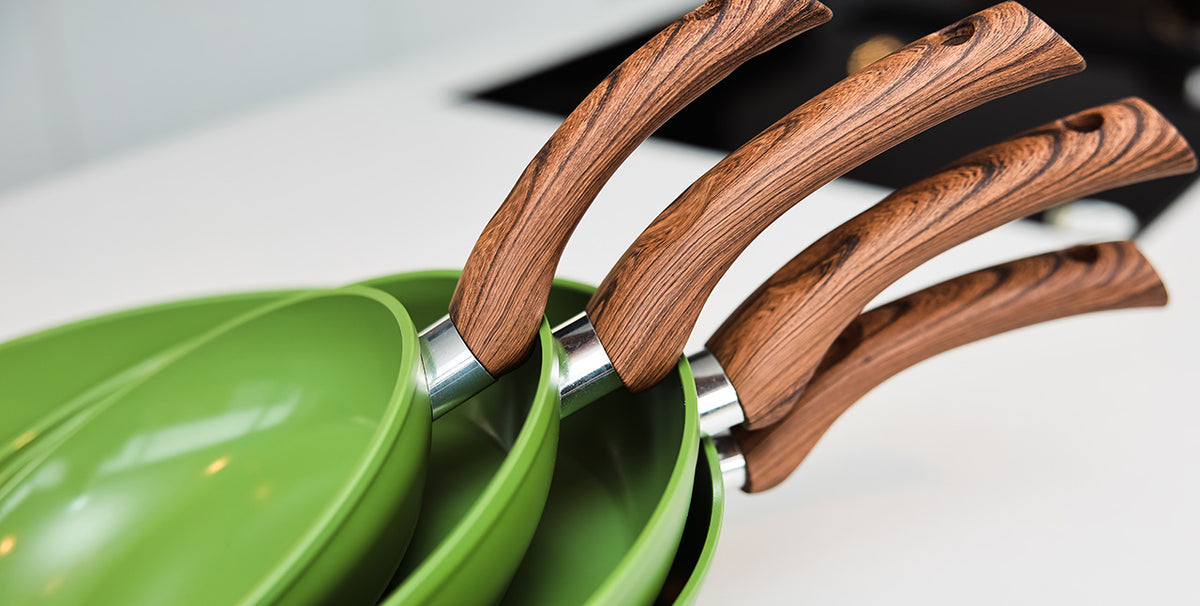
Grab the pan and move it. Does the handle wobble even a millimetre? Does the plastic feel thin and brittle? Is the fixing one single screw you could undo with your fingernail? All red flags. A handle has to be sturdy, ergonomic in your hand and not get too hot in normal use. A wobbly handle today is a dangerous pan in a few months. And a too-thin, slippery handle creates burn risk the moment you start serious cooking.
Signal 6: the pan smells strange out of the box
Sounds odd, but it's a serious point. Unpacking a new pan and it smells strongly chemical, even after a thorough first wash? That signals cheap materials or poorly cured coatings. A good pan smells essentially neutral or at most lightly of metal and oil. A pan that fills your kitchen with a sharp smell isn't a great start to a long relationship.
Signal 7: not a word about PFAS, material origin or sustainability
Things have changed in pan-land in recent years. PFAS is under pressure, consumers want to know what they bring home, and brands with nothing to hide communicate openly about it. A brand that doesn't say a word about what's in the coating, where the material comes from or whether harmful substances are used: leave it. We've long had a PFAS-free frying pan collection and are clear about what's in and what isn't. Demand that from every brand you consider.
What a good pan does and has
- A flat, sturdy base that has full contact with your hob
- A coating applied in multiple layers with visible thickness
- Complete specifications without misty terms or marketing speak
- A handle that sits firmly and stays bearably cool in normal use
- Open communication on materials, coating type and any certifications
- A decent guarantee the brand actually stands behind
Guarantee as a truth serum
How a brand handles guarantee speaks volumes. A short one-year guarantee whispers: we don't expect this to last either. A serious guarantee that mirrors the product's lifespan, plus a trial period in which you can use the product and still send it back, whispers something very different. At Cook & Pan you get 7 years guarantee on manufacturing and material defects, 25 years on cast iron and 60 days trial cooking. You don't do that if you don't believe in what you sell.
The bad-purchase checklist for shop or webshop
- Does the base feel sturdy and heavy, or light and ultra-thin?
- Can you see the coating in thickness, or is it flat and thin?
- Are all specifications clearly stated, including material and coating type?
- What's the guarantee period and is there a trial period?
- Is PFAS-free or material origin explicitly mentioned?
- Does the handle feel sturdy and ergonomic, or wobbly and cheap?
- Does the price match what you're holding, or is it suspiciously low?
Induction makes it extra important
Anyone cooking on induction can't afford a bad pan purchase. Induction heats lightning fast and demands a lot from the base. A thin pan warps from the heat, an uneven base makes poor contact with the hob and produces cooking noises or bad results. Read our piece on what really makes a good induction pan if you doubt. A good induction pan feels heavy, has a thick sandwich base and is sold by the manufacturer with explicit induction specs. Not "also suitable for induction" in small print, but simply: built for induction.
Coatings aren't all the same
Non-stick is not a brand and not a material, it's a property. Under that umbrella sit very different techniques: PTFE coatings (the old familiar one, often with PFAS residue in the process), ceramic coatings (PFAS-free, heat-resistant but requiring careful care), hardened steel and cast iron with natural patina. Want to dig deeper into which coatings are good and which are harmful? Read how to recognise a pan with harmful coating. When in doubt: choose transparency and certificates, not pretty stories.
Buying for the whole set
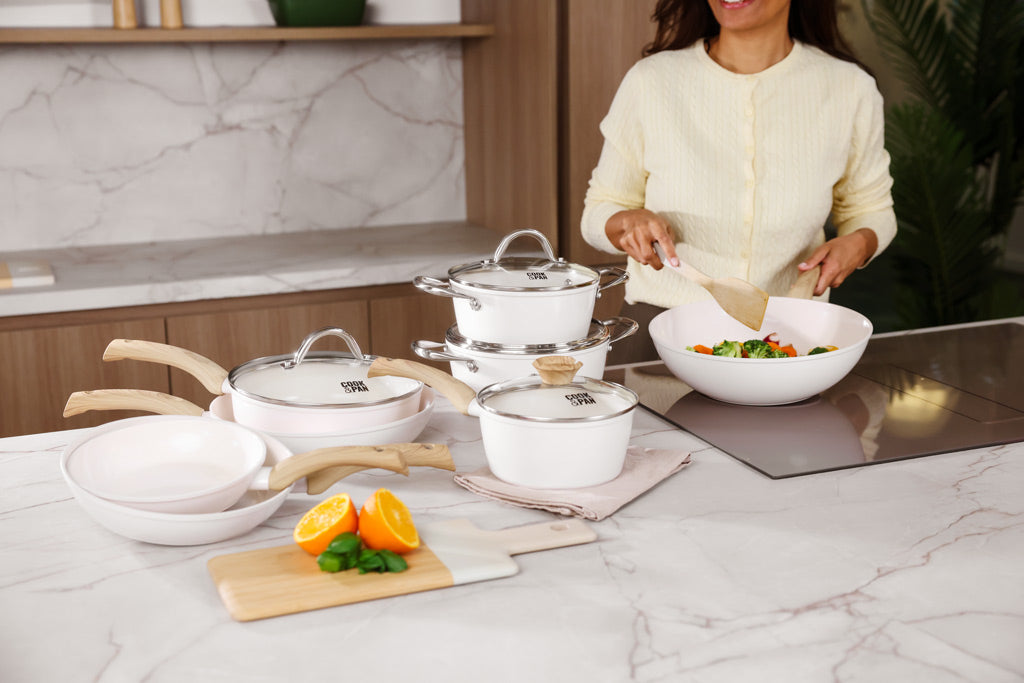
With a complete pan set the risks are bigger, because one bad purchase becomes six bad purchases. Check each item separately against all signals above. A tempting set of nine pieces can in reality be three pans you use and six gathering dust in the cupboard. Better three good pans you reach for daily than a battery of mediocre pans you never touch. And above all check that the sizes match what you actually cook: a big 28 cm frying pan for a two-person household is usually overkill, a 24 cm frying pan is for most kitchens a golden middle.
What to do when the bad purchase has happened
Did you buy that budget pan against better judgement and is it already a disaster? Good news: you don't have to bin it straight away. Read our piece on what to do with a broken pan for more sustainable options. Some pans you can still use for specific tasks (boiling water, cooking non-sticky things), others you can drop off at metal recycling. And next time? You'll be armed with this checklist. Also have a look at our PFAS-free cooking pot collection if you're rethinking the whole setup.
Not a bad purchase, but a long relationship
Buying a pan isn't an impulse action, it's an investment in years of cooking pleasure. A well-chosen pan becomes your friend: you know its character, you know what it's good at, and you almost forget it's there because it just always does what you ask. A bad purchase is a pan you curse daily, that costs you time, energy and ultimately money. Invest properly once, do your homework, and you're set for years. A pan you use six times a week deserves more attention at purchase than five minutes in a queue at the discounter. Cook & Pan stands for pans that are transparent about what they are, fairly priced and lasting for years. And if you still hesitate: take them into your kitchen for 60 days and see if they fit you. That's not a bad purchase, that's a choice.
💡 Please note: we love cooking with boldness, but safety always comes first. Read more on our disclaimer page.