









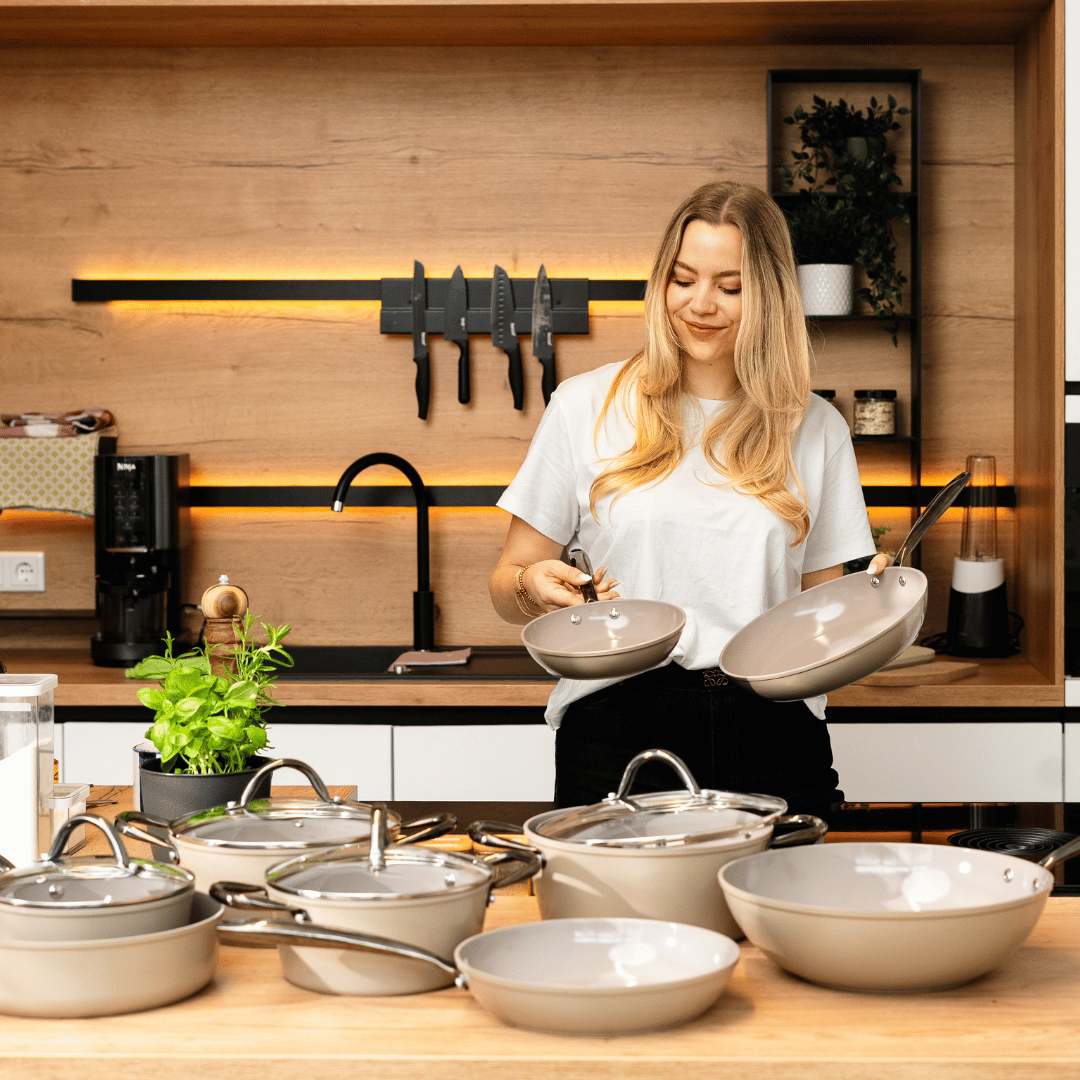

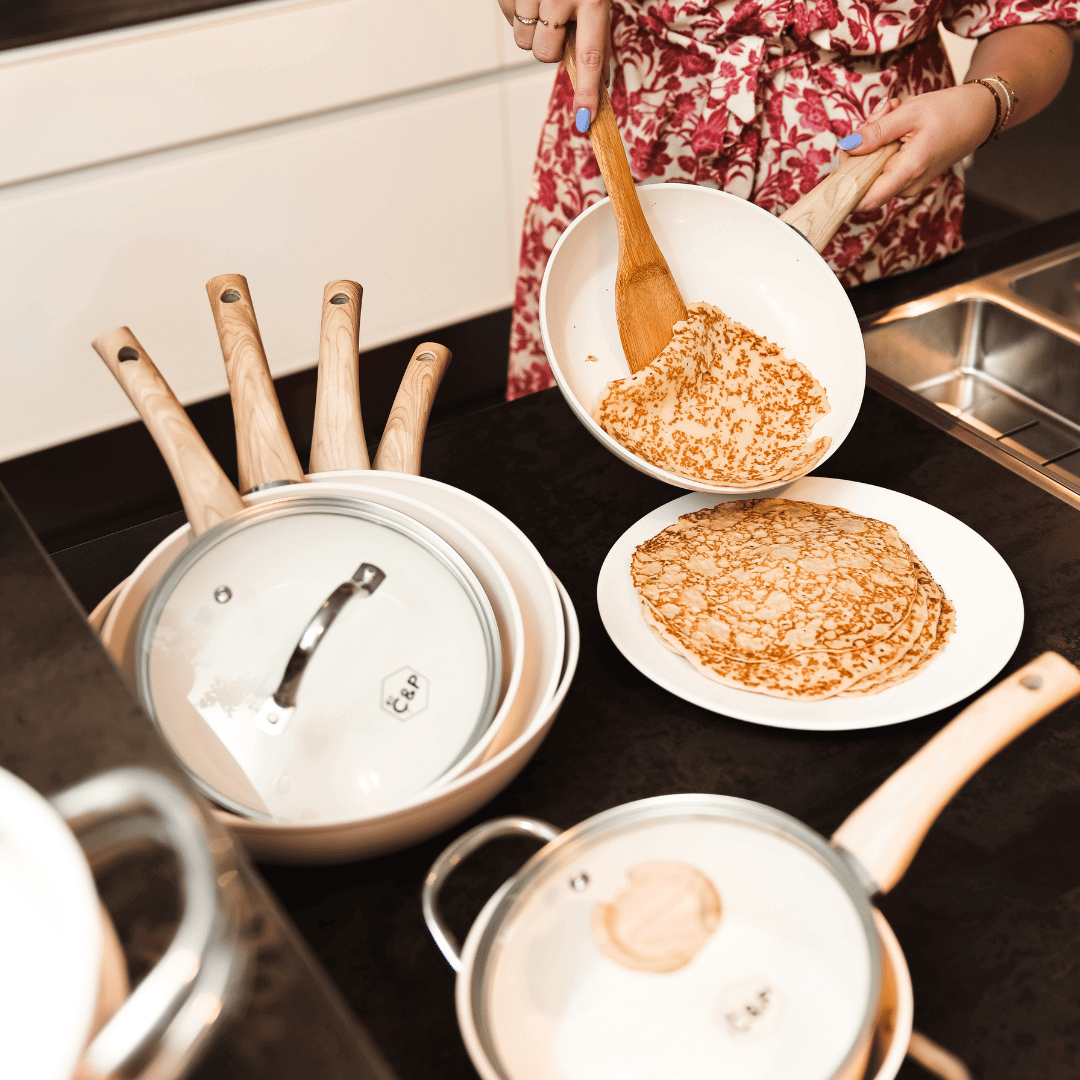
















No garden, no balcony space for a BBQ, or simply no desire to fire up the charcoal again? Good news: that smoky crust, those crisp grill marks and that juicy centre come out just as well on your induction hob. The secret isn't fire, but the right pan and a bit of technique. Here's which grill pan makes the difference, how to bring it up to temperature without setting off your smoke alarm, and which mistakes every beginner makes once.
Why a grill pan at home works almost as well as a BBQ
A BBQ does three things: deliver high heat, let moisture escape and put marks on your meat. A good grill pan does exactly the same, only indoors, on induction and without half an hour of preheating. The ribs lift your steak, chicken breast or courgette just above the base, so the released moisture evaporates underneath instead of pooling. The result is the same Maillard reaction as on a barbecue: brown crust, deep flavour, no steamed chicken.
What sets a grill pan apart from a regular frying pan
A grill pan isn't a frying pan with stripes. It's a completely different tool. With a regular frying pan, your food has full contact with the base, giving an even crust but no grill effect. With a grill pan, only the top of the ribs touches your meat, which delivers:
- Marks that look professional (and taste good, because the ribs get the hottest spot).
- Less moisture under your meat, so no "boiled" effect.
- Fat that drains between the ribs, so your dish ends up less greasy.
- A smoky touch from light caramelising of the juices between the ribs.

Which material suits your cooking style?
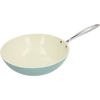
Cook & Pan offers grill pans in several materials, and honestly: there's no objectively best choice. But there is a best choice for you. The three flavours in a row:
Aluminium with ceramic non-stick coating
Heats up fast, easy to clean, pleasantly light in the hand. Perfect for weeknight grilling of fish, chicken or vegetables. The ceramic coating is PFAS-free and doesn't grab on. Want to know more about how this coating behaves, also read our blog about the difference between ceramic and teflon coatings.
Cast iron
The heavyweight in the cupboard, literally and figuratively. Slow to warm up but holds heat like nothing else, so your steak doesn't sag the moment it hits the pan. Asks for a bit more care, but lasts decades. There's a reason we cover cast iron with a 25-year manufacturer's warranty.
Stainless steel
Scratch-resistant, endlessly durable and no coating that can wear off. Does ask for a bit more cooking experience: too little fat or a pan that hasn't been preheated and your meat sticks. But if you love being in full control of your heat, this is your spot.
Which size do you actually need?
A grill pan of 28 cm is the golden middle for most households. Big enough for two chicken breasts side by side or a generous batch of vegetables, but still manageable when washing or storing. Cooking more often for one or two? A smaller size will do fine. Got a big family? Have a look at our larger models or a saute pan for combinations of grilling and braising.
Does a grill pan also just work on induction?
All Cook & Pan grill pans are induction-suitable, so that's sorted. Important to know: never set your induction hob higher than 80 percent of maximum, and don't use the boost function. Induction transfers heat so directly that your pan warps at the highest setting or the coating gets damaged. Unsure whether a pan from another brand is suitable? Do the magnet test: if a fridge magnet sticks to the base, the pan works on induction.
Preheating, the bit everyone gets wrong
A grill pan needs to be properly hot before you load it, or you'll end up with pale meat without marks. The trick: preheat the pan calmly on medium-high heat (60 to 70 percent on induction) for two to three minutes. Test with a drop of water: if it dances across the ribs, the pan is ready. If it evaporates instantly with a hiss, you're already perfect.
What you should never do: put an empty pan on the highest setting and just wait. That's the fastest route to carbonisation, a warped base and damaged coating, and that's exactly where the warranty stops.
Meat, fish and vegetables: the right approach per ingredient
Not everything that goes in the grill pan asks for the same treatment. A short cheat sheet:
- Steak or beef: pat dry, rub with a thin layer of peanut or sunflower oil, lay it down and don't move it. Only flip when the marks are clearly visible (usually 2 to 3 minutes).
- Chicken breast: flatten the thicker side slightly so it cooks evenly. Grill 4 minutes per side on medium-high, rest 2 minutes on a cutting board.
- Fish (salmon, tuna): oil the fish side, not the pan. Skin-side first, press lightly so the skin makes even contact with the ribs.
- Vegetables: cut into firm slices (courgette, aubergine, pepper), brush with olive oil and a pinch of salt. One flip is enough.
- Halloumi or tofu: pat extra dry and use barely any oil, otherwise they slide across the ribs.
Oil on the food, not in the pan
A common beginner's mistake: throwing a glug of oil into the hot pan. With a grill pan, that's unnecessary and even unhelpful, because the oil pools between the ribs and starts smoking. If you brush your meat or vegetables with a thin layer of oil, you get better marks, less smoke and no sticky residue. Choose an oil with a high smoke point such as peanut, sunflower or mild olive oil. Extra virgin olive oil and cooking sprays are best skipped, they leave a sticky film that's hard to get off.
Why your grill pan stops cooperating after a while
Have you ever had a pan where your meat started sticking again after six months? Big chance it was overheating, a dishwasher cycle or steel utensils that cut open the coating. Our ceramic coating has a 2-year warranty, cast iron has a 25-year manufacturer's warranty and all other components 7 years. We stand behind that, as long as you treat the pan as intended. Take the one moment to follow our guidelines and your grill pan stays your best cooking buddy for years.
Cleaning the grill pan without wrecking the coating
Between those ribs, something always lingers. Here's what works, and what to avoid:
- Do: let the pan cool down completely first. Holding it hot under cold water gives thermal shock, a warped base and at worst a cracked coating.
- Do: warm water, a mild washing-up liquid and a soft brush or nylon sponge.
- Do for stuck-on bits: a layer of water with a splash of natural vinegar or lemon juice, briefly heat, let cool and rinse off.
- Don't: the dishwasher. Even if the manufacturer says it can, you halve the lifespan through aggressive tablets and eco-mode with concentrated soapy water.
- Don't: steel wool, scouring powder or a knife to chip baked-on food off.
- Don't: oven cleaner or bleach. Really not.
Grilling without a smoke alarm in your face
Not every extractor hood is the same, and not everyone wants to air out the whole flat while cooking. A few simple tweaks prevent smoke clouds:
- Use an oil with a high smoke point; extra virgin olive oil starts smoking around 160 degrees already.
- Brush oil onto your food, not into the pan, so loose drops don't burn between the ribs.
- Keep your induction at maximum 80 percent and skip the boost. Too much heat = more smoke and a higher chance of coating damage.
- Switch on your extractor hood straight away, not only when you can already smell smoke.
- Wipe loose charred bits out of the pan between rounds with a paper towel.
Combine with a saute pan for the full picture
Grilling is fantastic for the lead role, but side dishes ask for something else. A saute pan is your perfect sidekick: high sides, broad base and room to gently soften onions, peppers or mushrooms while your grill pan goes full speed. To learn why this duo works so well, also read about the differences between saute pan and frying pan.
Common mistakes when grilling on a grill pan
- Starting too cold: result is grey meat without marks. Patience with preheating always pays off.
- Overloading: more moisture in the pan than can evaporate, so steaming instead of grilling. Work in two batches.
- Constantly flipping: grill marks only appear if your meat stays put long enough. One flip is usually enough.
- Letting marinade drip in: sugary marinades burn and stick between the ribs. Pat your meat lightly before it goes in.
- Using the boost function: sounds like fast grilling, ends as a warped base and broken coating. Don't.
Grilling in every season, not just summer
A BBQ stays seasonal for most people. A grill pan doesn't. In February an entrecote with roasted vegetables, in October a grilled halloumi in a wrap, in July fish with grill marks on the patio: all possible within ten minutes from your induction hob. And you don't need a chimney for the smoky effect, just a properly preheated pan and a bit of patience.
Ready to grill indoors?
A good grill pan doesn't replace a BBQ, but it takes the work and seasonal limit out of the equation. Whether you go for light aluminium, powerful cast iron or durable stainless steel: have a look at the full range of grill pans, saute pans and snack pans and find the one that suits your kitchen. And if in doubt about what's safe in your pans, also read our blog about toxic substances in pans.
💡 Please note: we love cooking with boldness, but safety always comes first. Read more on our disclaimer page.