
























Oil, butter or that spray can in your cupboard? The temptations in the oil corner are bigger than ever: peanut, sunflower, olive oil in four grades, clarified butter, coconut fat, and those mysterious cooking sprays you don't really know what's in. Which one do you pick if you want to use a ceramic pan optimally? The good news: the rules are simpler than you think. The better news: once you get them, you cook better forever.
The smoke point: the quiet hero of your fat
Every oil and butter has a moment when it starts to smoke and then burns. That's called the smoke point, and it decides whether your fat becomes your friend or your enemy in the pan. Cook below the smoke point and you get a lovely cook-and-brown reaction. Cook above it and you get a bitter, burnt taste and a greasy smoke cloud in your kitchen. Even worse: the residues burn into your coating, exactly what you want to avoid.
Why extra virgin olive oil doesn't belong in your frying pan
Yes, extra virgin olive oil is healthy. Yes, it tastes wonderful. No, it doesn't belong in your hot pan. The reason: extra virgin has a low smoke point of around 160 to 190 degrees Celsius, while a good frying heat in your pan already sits around 200 degrees. Put your pan on medium-high, pour in extra virgin, and the oil burns before your meat gets a brown crust. So save your expensive olive oil for dressings, herb butter, pesto and finishing drizzles just before serving.
The oils that love your frying pan
- Peanut oil: smoke point around 230 degrees, neutral flavour, perfect for wokking and searing.
- Sunflower oil (refined): smoke point around 230 degrees, cheap and neutral.
- Rice bran oil: smoke point around 250 degrees, very light in flavour, ideal for delicate dishes.
- Clarified butter (ghee): smoke point around 250 degrees, rich and nutty in flavour.
- Mild olive oil (refined): smoke point around 210 degrees, fine for regular cooking.
Butter: the flavour-maker with a middle way
Who doesn't love a fried egg in butter? Regular butter just has a low smoke point (around 150 degrees) because of the milk proteins. On medium heat, butter is fantastic, but turn the dial above 6 out of 9 and it goes brown-to-black in half a minute. Two smart solutions: combine butter with a splash of oil (so it can handle higher temperatures together), or choose clarified butter, where the proteins have been removed. Ghee is basically butter on steroids: buttery in flavour, but heat-resistant up to 250 degrees.
Cooking sprays: why to stay away
They look so handy: a spritz and done. But cooking sprays aren't just oil in a can. They contain propellants, emulsifiers and often silicones to make the spray fine. Those additives have an extremely low smoke point and leave an invisible, sticky film on your pan. That film burns on at every next cook and creates, within a few weeks, the classic "my ceramic pan suddenly sticks". Skip them. Use a decent oil in a refillable bottle, and your pan stays itself.
How much fat do you actually need?
Rule of thumb: just enough to cover the surface without a puddle. For a 28 cm frying pan, about one tablespoon is enough to get a nice cooking effect. With a well-working Cook & Pan ceramic coating you need even less than you're used to, because the coating already releases on its own. Less oil means not just a lighter dish, but also less risk of burning and burn-in.
Adding flavour with the right oil
Not every oil is neutral, and that's useful to know. A drizzle of nut oil (walnut, hazelnut) near the end of cooking gives a beautiful aroma, but only as a final touch, never as a frying fat. Clarified butter gives a rich, almond-like base, ideal for fish with herbs. Sesame oil is fantastic in a finished stir-fry, but burns quickly. So: high heat in the pan = neutral and heat-resistant. Flavour in reserve = after the pan, on your plate.
The mini-course: which fat for which dish?
- Searing steak: peanut or rice bran oil, setting 7 out of 9.
- Frying egg: butter or a combo of butter plus a drop of oil, setting 5 out of 9.
- Pancake: butter, setting 5 to 6 out of 9.
- Browning chicken: refined olive oil or peanut oil, setting 6 out of 9.
- Wokking: peanut oil, setting 7 to 8 out of 9 in short bursts.
- Finishing a sauce: extra virgin olive oil, cold drizzle, no pan needed.
Why a Cook & Pan ceramic pan makes your choices easier
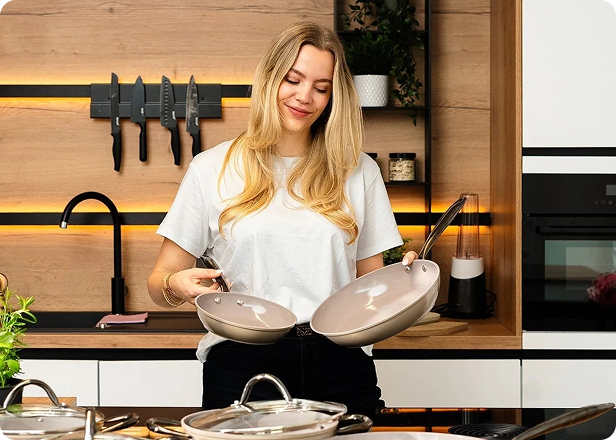
The ceramic coatings on our aluminium frying pans have a naturally very low stick tendency, which means you're not forced to use a puddle of oil for reassurance. That's a well-underestimated advantage: less fat means longer coating joy, less smoke, healthier dishes and a simpler choice at the stove. No pricey sprays, no strange fats, just a nice bottle of peanut or rice bran oil and a pack of butter. Done.
The top five mistakes with oil in the kitchen
- Pouring extra virgin olive oil in a hot pan and being surprised it smokes.
- Letting butter melt on setting 9 (spoiler: it burns in fifteen seconds).
- Using cooking sprays "because it sounds healthier" (hint: it isn't).
- Using too much fat, after which the excess soaks into the coating.
- Using old, rancid oil that's long past fresh. Oil has a shelf life, like your yoghurt.
Storing oil: a small effort, big win
Light and heat are oil's enemies. So don't keep your bottles right next to the stove, however handy that seems. A cupboard further away, dark, cool, sealed: that's where oil keeps its fresh flavour and high smoke point. Opened bottles use within a few months, because after that they slowly oxidise and take on a metallic off-note you don't want in your cookware.
Go fat with knowledge
Cooking is a quiet dialogue between you, your pan and your ingredients. Your oil is the translator that makes sure everyone speaks the same language. Choose the right one, keep the heat in check, and you'll get cooking results you're proud of. An aluminium or stainless steel frying pan from Cook & Pan is designed to deliver maximum flavour with minimum fat. Fill it with the right oil, give it the right temperature, and you have a combination that will surprise you every evening. Enjoy.
💡 Please note: we love cooking with boldness, but safety always comes first. Read more on our disclaimer page.