






























You know the feeling? You pull your pan out of the wash, it glistens like a fresh apple and you set it lovingly in the cupboard. Days later: you fry an egg and it sticks like it's glued. How did that happen? The answer lives in an invisible film of grease you didn't see, but your pan did. And the test to spot it, you run with your own fingers. Welcome to the roughness test, the fastest quality check in your kitchen.
The difference between visually clean and actually clean
Our eyes are fantastic, but not foolproof. A pan that looks like glass can still carry an invisible grease film, and that film is the problem. The next time you cook, that film heats up, forms a sticky layer on the coating, and from that moment on everything you fry sticks. Beauty is in the eye of the beholder, beauty in a pan is in your fingertips.
What is the roughness test exactly?
The roughness test is simple. You dry your pan, run two dry fingers over the inside and feel. Rough means clean. Smooth, silky or a bit greasy means: back in the sink. That's it. No gadgets, no products, just a finger and a second of attention.
Why your pan sometimes feels "smooth" by mistake
When a pan is new, it feels smooth, that's true. But a well-cleaned used pan should feel subtly rough because there's no oil film on it. That roughness is not a bad condition, quite the opposite: it's the sign that the coating is doing its job. A smooth feeling after a cooking session almost always means something has been left behind that shouldn't be there.
From protein to starch: the culprits in a row
So what's actually in that invisible film?
- Microscopic protein remains from eggs or meat.
- Starch particles from pasta, potatoes or rice.
- An oil film, especially after cooking sprays or extra virgin olive oil.
- Sugar residue from sauces that quietly caramelised.
All these mini-ingredients share one thing: they bake back on next time and bond firmly with the coating. That's how the familiar picture builds up over time: a pan that used to fry wonderfully and suddenly lets everything stick.
The follow-up test: the oil cloth
Want extra certainty? Take a clean, dry kitchen paper or white cloth, put a drop of neutral oil on it and rub over the dry, "clean" pan a few times. Does the cloth turn dirty? There was still something on it. Does the cloth stay clean? Congratulations, your pan is ready to cook. This test is especially useful on ceramic and aluminium pans, where invisible films are almost impossible to spot with the eye.
Why the dishwasher can give a false sense of clean
A pan from the dishwasher can look magnificent while still carrying a thin layer of rinse aid or food residue. Especially on the eco cycle, which uses less water, detergent stays more concentrated. So after every dishwasher load, do the roughness test: two fingers, a quick feel. Does it feel greasy? Briefly rinse by hand with mild soap, and you know it's right.
How to make the roughness test a standing ritual
Small habits change big things. Put a note on the dishwasher door or on your dishbrush: "feel your pan". After two weeks you don't need to think about it anymore, you just do it, like someone who always tests the tyre before getting on the bike. A healthy reflex, then. And a reflex that keeps your coating in top shape for years.
What to do when your pan feels smooth
- Let a layer of hot water and a dash of mild soap soak in the pan.
- Rub with a soft brush or sponge around, including the rim.
- Rinse with warm water, dry thoroughly with a clean cloth.
- Do the roughness test again. Nine out of ten times it's right now.
- Is it not? Then use a layer of water with some vinegar or lemon juice, put briefly on the stove, let cool, and wash normally. This loosens baked-on residue without damaging the coating.
Why a Cook & Pan frying pan rewards this check generously
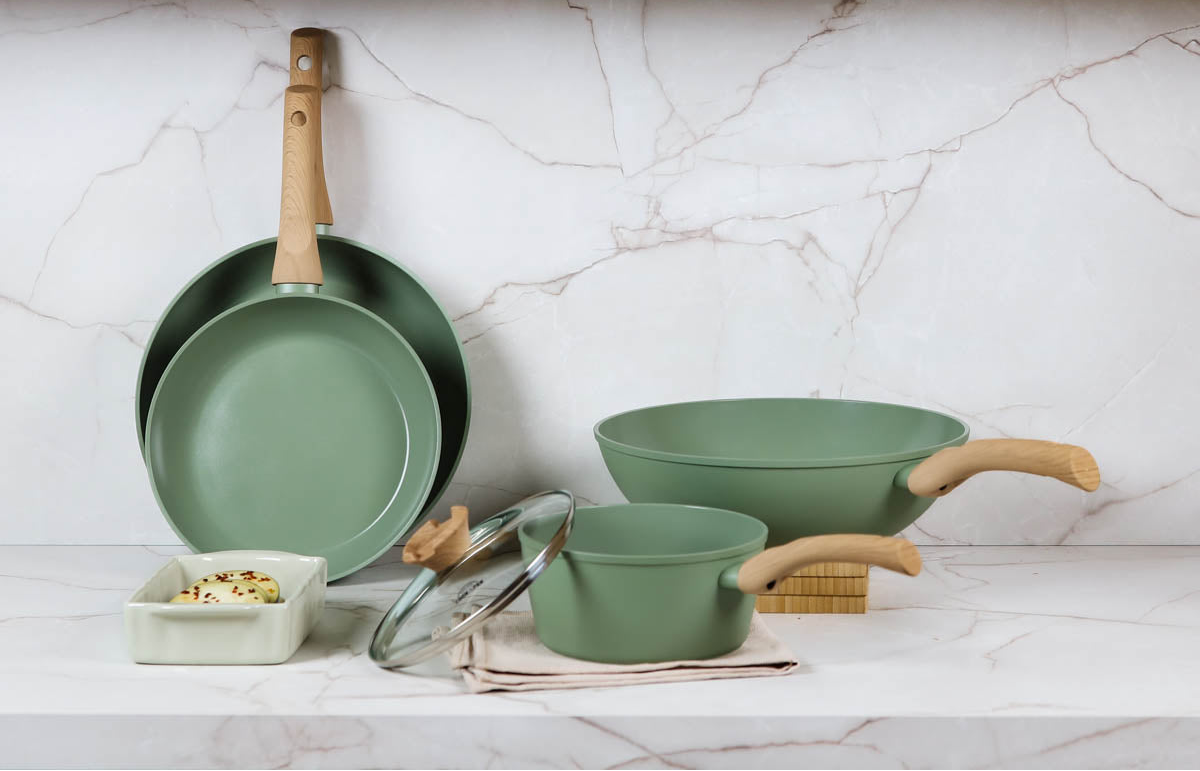
Our coatings are designed to stay smooth for years with minimal maintenance. The ceramic layer on our aluminium frying pans has a naturally even surface that doesn't turn porous even after intensive use, as long as you keep it roughness-clean. The stainless steel pans have a fine structure that releases fat easily. And our cast iron pans with enamel have a glass-like finish that reveals itself quickly: if something is left behind, you feel it immediately. In every case, the roughness test is your ally.
Five signals that your pan needs a deep clean
- Your fried egg suddenly sticks, when it never used to.
- Your pan feels "silky" after the wash instead of rough.
- A dull sheen appears in the centre of the pan.
- The oil cloth turns brown or yellow in the follow-up test.
- Light rings show up after cooking that a regular wash won't shift.
The link between roughness and lifespan
A well-maintained pan simply lasts longer. Years longer, in some cases. That's good for your wallet, good for the environment and good for your cooking joy. The roughness test is the smallest gesture with the biggest effect. Not a tip you forget tomorrow, but a one-second action that your pan will thank you for today.
Feeling is knowing
Cooking is a sensory activity: you smell, you taste, you look. Add "feeling" to that list. The roughness test takes less time than pouring a glass of water, and it gives you the daily confirmation that your pan is ready for work. Combine it with a pan from the Cook & Pan collection built to pass this check, and you cook on a foundation that won't let you down. Touching is knowing, and knowing is frying like a boss.
💡 Please note: we love cooking with boldness, but safety always comes first. Read more on our disclaimer page.