









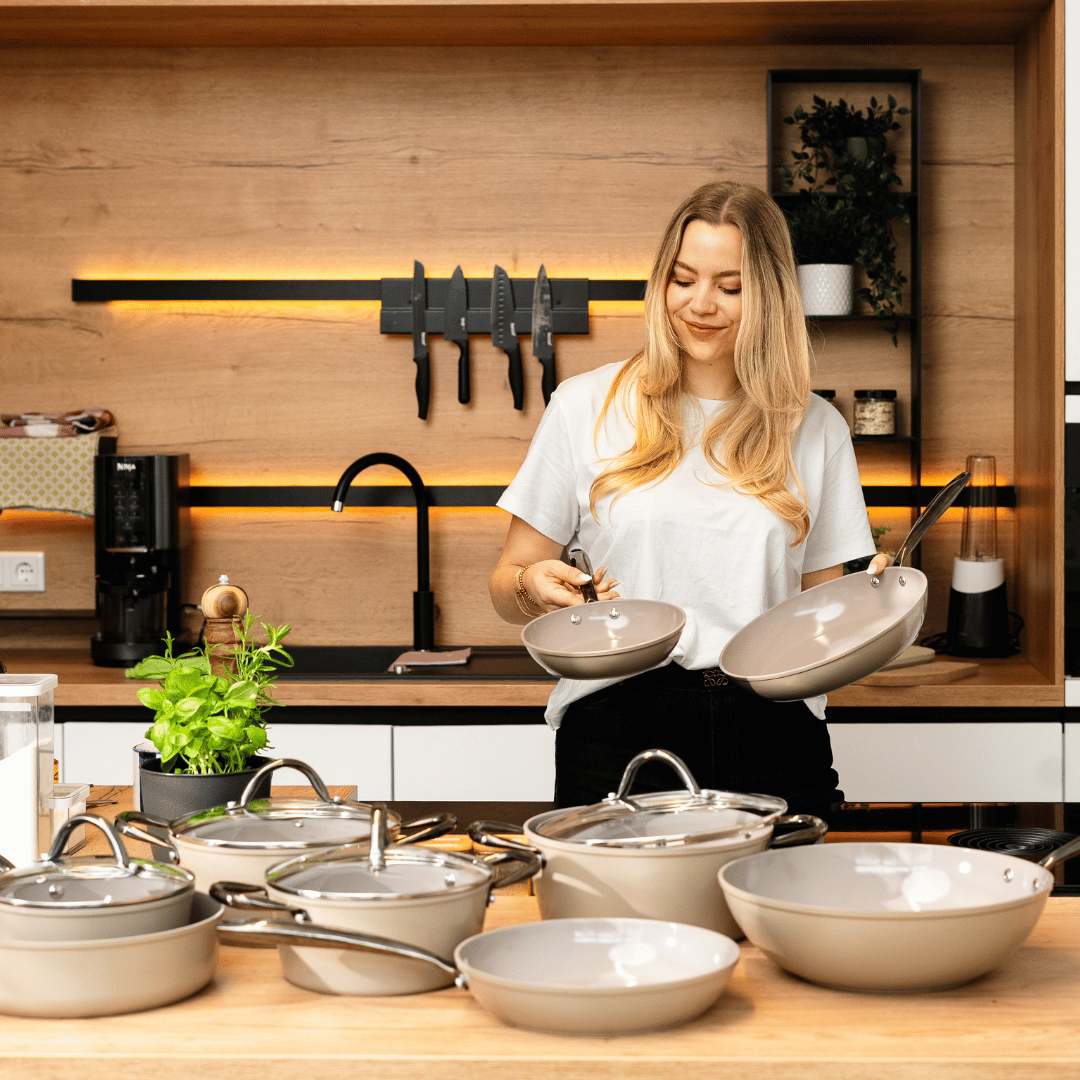

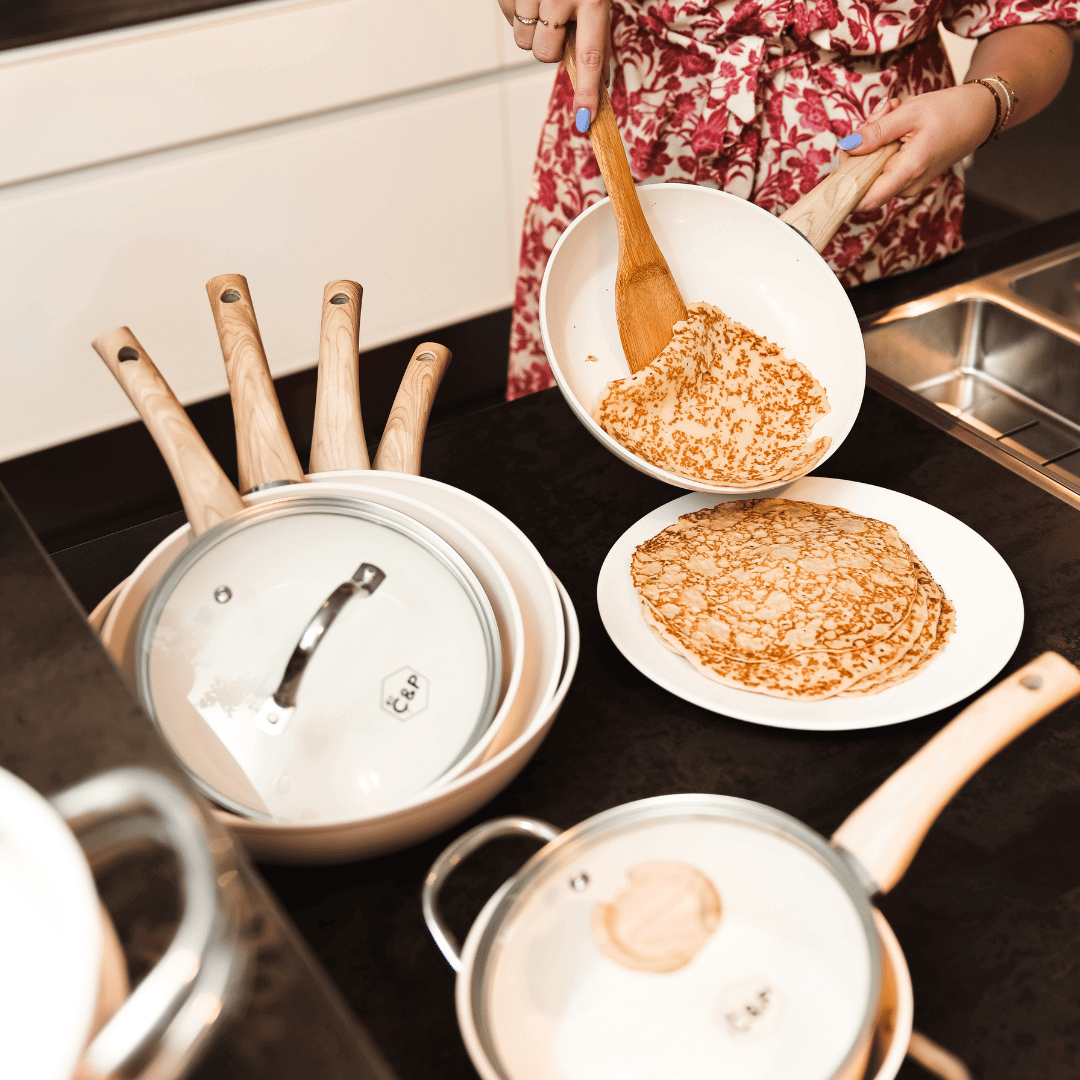


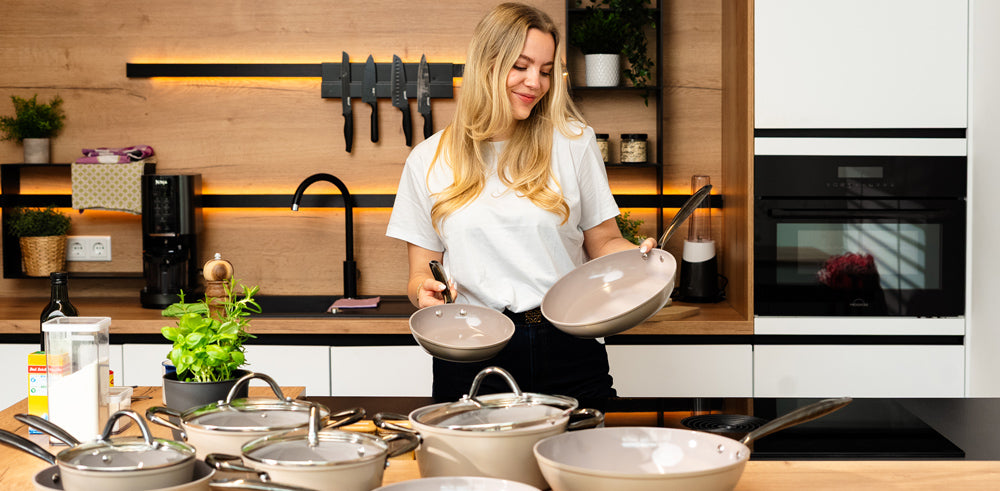
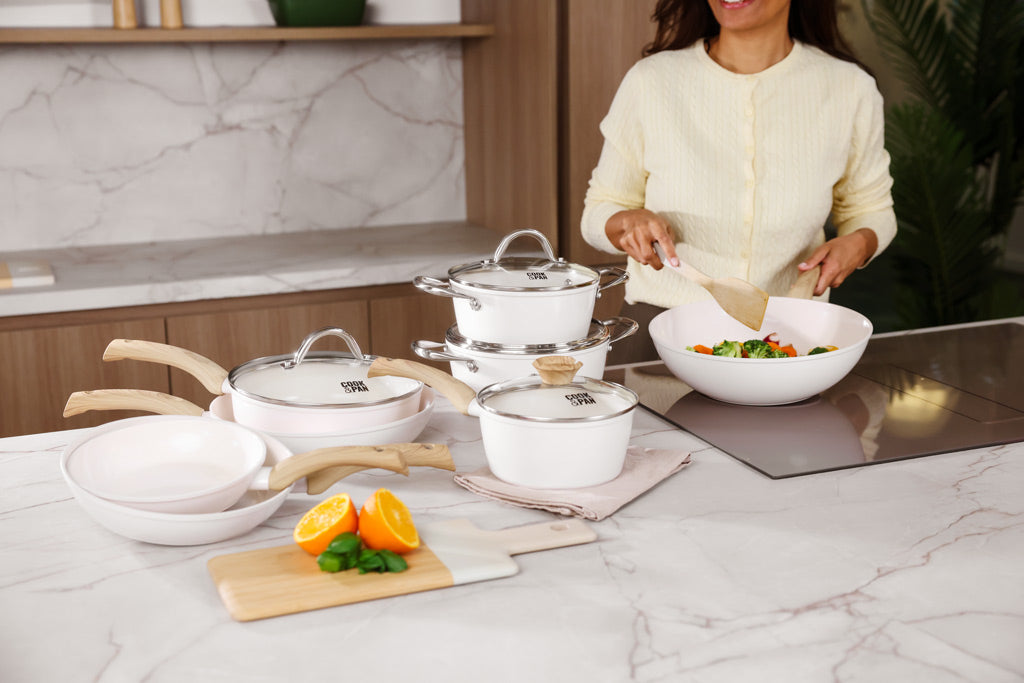











You have bought a pan. Or you are about to choose one and wondering what you should actually look out for. Everything is gathered right here: which pan is for what, how to treat it in the first week, what to do when it sticks or discolours, and how to make sure it lasts for years. Read it once and you are sorted.
Work your way through from top to bottom, or jump straight to the bit you need right now.
Which pan do you use for what?
Most kitchens need three or four, not twelve. Roughly speaking:
- Frying pan: eggs, fish, vegetables, anything that cooks quickly and needs room to brown.
- Sauté pan: higher sides, so stir-fries, risotto and curry without your hob becoming the victim.
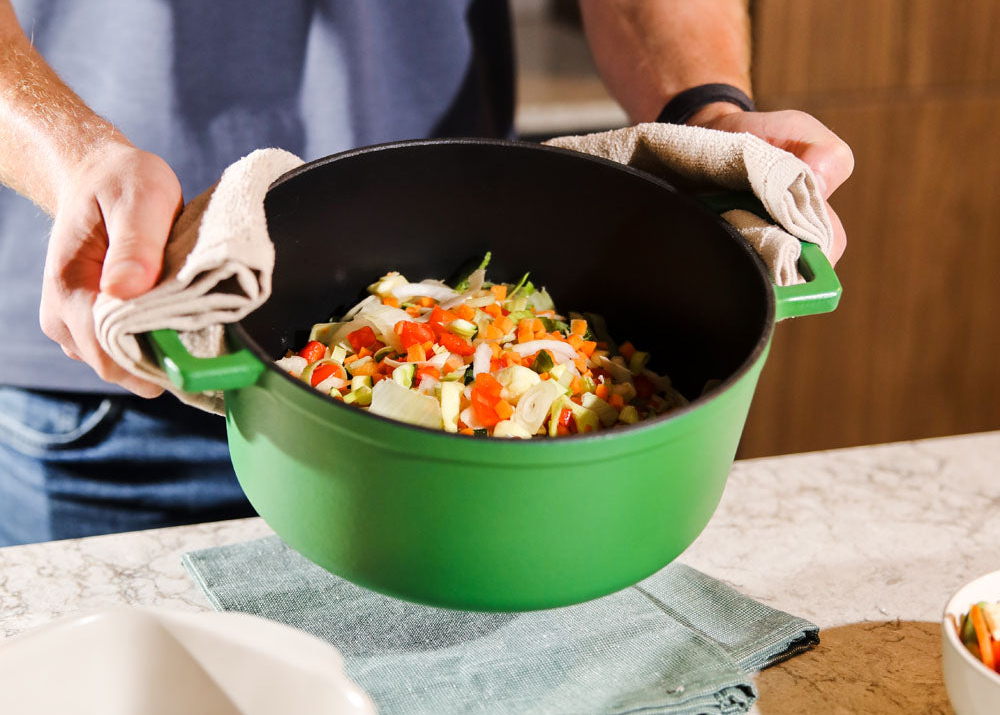
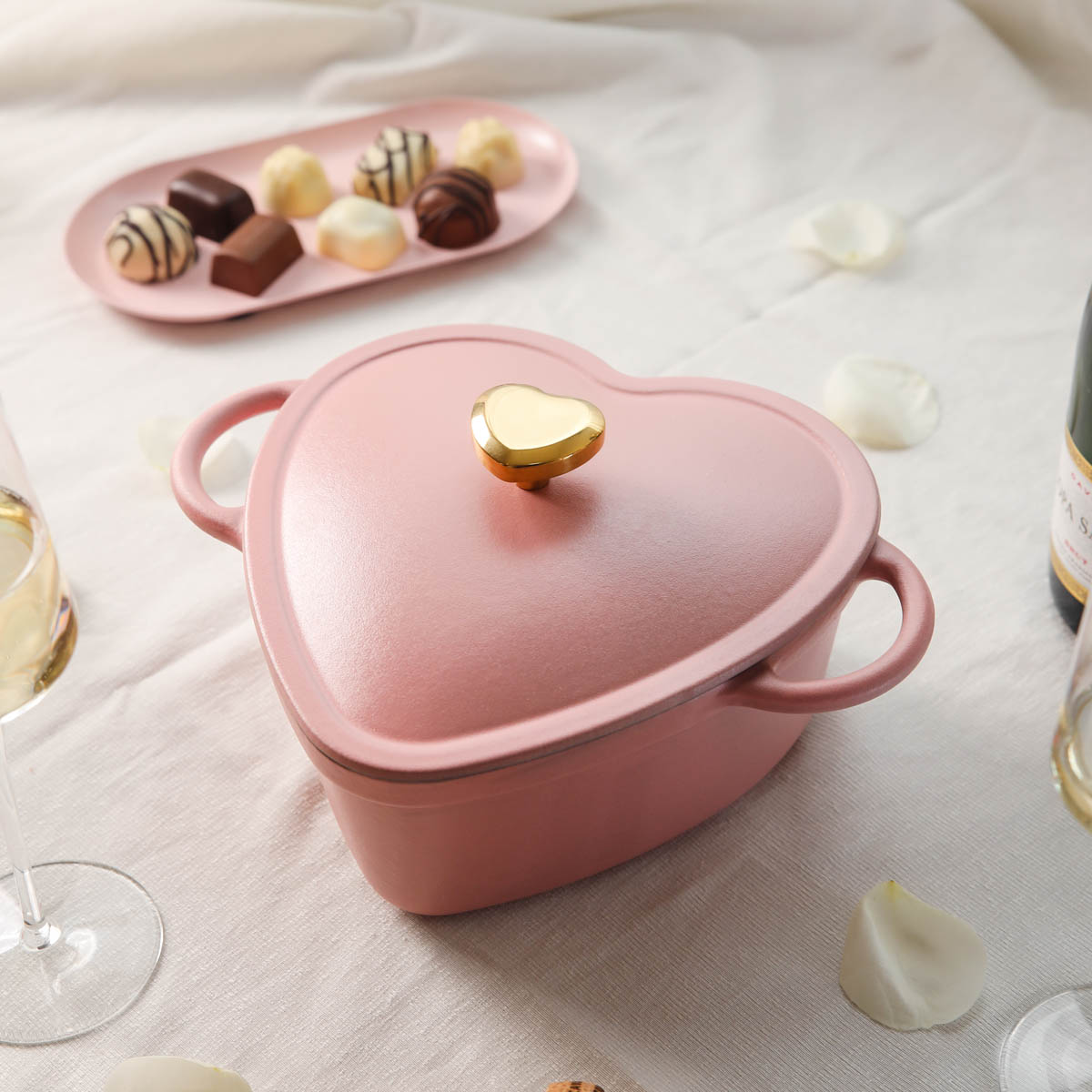
- Casserole pot: stews, slow simmering, anything that needs a lid and time.
- Cooking pot: pasta, potatoes, soup.
- Saucepan: sauces, boiling an egg, warming milk, small portions.
- Wok pan: high heat, quick movement, lots of surface.
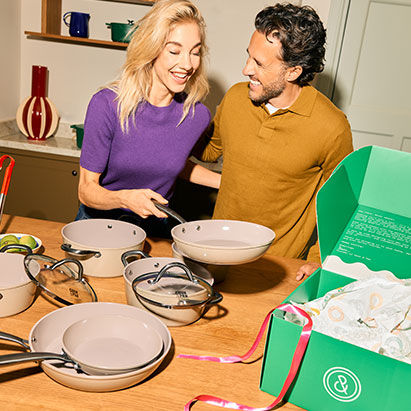
Starting from scratch? A frying pan, a casserole pot and a cooking pot will take you a long way. The rest will follow naturally. In our full range of pots and pans you can see everything at a glance.

Aluminium, stainless steel or cast iron: what is the difference?
Our pans come in three flavours, and they really do differ. Aluminium with a ceramic non-stick coating is light, heats up in no time and is the nicest all-rounder for everyday cooking. Stainless steel gives you control and those lovely browned bits you turn into a sauce. Cast iron holds heat like nothing else and, with a little care, will outlast your cooking plans.
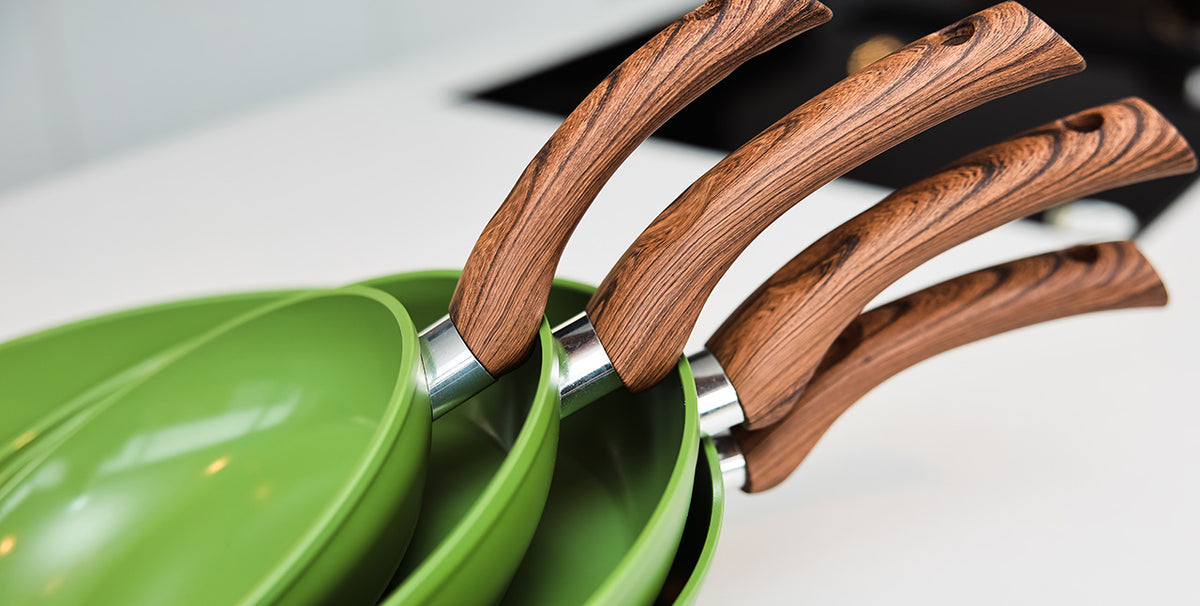
A quick word of honesty about the word ceramic: a ceramic pan is not solid ceramic. It is an aluminium pan with a ceramic coating on top. That coating is free from PFAS and PFOA, which is exactly why we choose it. But it is still a layer, and layers ask for a bit of attention. You can read what that attention involves further down. The whole ceramic range follows the same rules.

What size do you need?
A pan that is too big means the fat burns on the empty part. A pan that is too small means steaming instead of frying. A simple guide:
- 20 cm: one person, one egg, a handful of vegetables.
- 24 cm: two people, the size that ends up on the hob most often.
- 28 cm: three to four people, or anything that needs room to colour.
If you almost always cook for two but now and then for six, add a large one to your collection rather than doing everything in the biggest pan. A half-full large pan fries worse than a well-filled small one.

Unpacking your new pan: do this first
A quick rinse with warm water and a little washing-up liquid, dry it, done. That is all there is to it. Our ceramic pans do not need seasoning, they come out of the box ready to go. Why that works differently with us than with an old-fashioned carbon steel pan is explained in do you need to season a pan.
Take a look at the base and the coating straight away, before you start cooking. If something does not look the way it should, let us know right away rather than three months later.
The 80 percent rule on induction
Induction is faster than most people think. So fast that setting 9 heats your pan harder than it was made for. That is why there is one rule that makes everything easier: cook at a maximum of 80 percent of the power and leave the boost function alone. With cast iron you go a little lower still, 70 to 80 percent is plenty.
This is not about being overly careful, it is how these pans are designed. Ceramic conducts heat remarkably efficiently, so medium-high almost always does what you expect from high. Your dish will not cook any slower, but your pan will last years longer. The thinking behind that number is in why 80 percent is the new 100, and all our induction pans are built around it.
Preheating without wrecking your pan
Never put an empty, dry pan on the highest setting to heat it up quickly. That is the shortest route to a damaged coating and a base that warps. Always heat gradually and add your fat before the pan gets really hot.
A minute or two on medium-high is just right for most dishes. You will notice it yourself: flick a drop of water into the pan and when it sizzles and dances away, you are there.
Oil, butter or spray?
Choose a fat with a high smoke point: groundnut oil, rice bran oil, mild olive oil or simply butter. Extra virgin olive oil is delicious, but not for high temperatures. It starts to smoke and burn before your meat has browned.
We give cooking sprays a miss. The propellants and additives in them bake on into a sticky film that is almost impossible to remove, and it is exactly that film that makes people think their coating is broken. Which fat works best in which situation is explained in oil, butter or spray.
Which utensils your pan can handle
Wood, silicone or heat-resistant plastic: perfect. Steel spatulas, forks and whisks: better not. One careless swipe with a knife leaves a scratch that the coating will later start to lift around.
It is the cheapest insurance there is, because a good spatula costs less than a new pan. In our kitchen accessories you will find utensils that leave your coating in peace, and here you can read why metal makes such a difference.
Cleaning: let it cool first, then add water
Always let your pan cool down before it meets water. A hot pan under the cold tap gets a thermal shock: the material shrinks faster on the outside than on the inside, and you will see that in a warped base or a damaged coating. It will not go wrong the very first time, but it is exactly the kind of damage that builds up. More on that in hot pan under the cold tap.
After that, warm water, a drop of washing-up liquid and a soft sponge are all you need. If something is stuck on, let it soak for a while instead of scrubbing.
Can your pan go in the dishwasher?
The honest answer: washing by hand is always best, and it is done in thirty seconds. If it goes in the dishwasher anyway, stick to three things:
- No aggressive all-in-one tablets.
- No eco setting. Less water means more concentrated detergent, and that eats away at your coating.
- Dry it straight away once the programme has finished, so no limescale marks are left behind.
The full explanation, including what exactly happens during a programme like that, is in how your pan comes out of the dishwasher singing.
Discolouration, rainbow sheen and dull patches
A brownish haze, a bluish glow or a matt patch looks more dramatic than it is. Discolouration is a cosmetic flaw, not a defect. It comes from minerals in your tap water, from salt that went into a dry pan, or from heat that was just a bit higher than needed. Your pan cooks no worse for it.
What helps: briefly warm a layer of water with a splash of lemon juice or white vinegar, let it cool and rinse. From now on, only add salt once there is liquid or fat in the pan. And dry it with a tea towel instead of leaving it to drain.
Why your pan suddenly sticks
This is the classic one, and usually the coating is not broken but invisibly covered. When the heat is too high, fat and proteins burn into a thin, hard layer that bonds to the surface. That layer feels smooth, looks glossy and sticks like mad. So your egg is not frying on the coating, but on burnt fat.
The test takes ten seconds: rub a dry finger over the cold base. If it feels rough or slightly tacky, there is a film on it. Treat it as described above under discolouration, and nine times out of ten it will fry like it did on day one again. Still not working? Then pan sticking: how to avoid a kitchen crisis will help you further.
What makes a coating come loose
A coating that lifts at the edges or flakes off almost always has a clear cause. The four most common ones:
- Cooking at full power or with the boost function, which overheats the layer.
- A scratch from metal utensils, around which the coating then starts to lift.
- A hot pan that went under the cold tap.
- Months of going through the dishwasher on the eco setting.
If none of these four ring a bell and you still see damage, especially when the pan is fairly new, then something else is going on. In that case, take a few clear photos of the whole pan, the base and the damage itself. Then we will take a look with you.
A warped or bulging base
A pan that starts to wobble, or where the oil runs to the edge, almost always has the same story: heated too quickly, or cooled too quickly. Metal expands with heat and contracts with cold, and when that happens too abruptly the base no longer returns to completely flat.
Heating gradually and letting it cool down calmly prevents it almost entirely. Has your pan already bulged? Then check warped pan or bulging base to see what you can still do and when it is game over.
Exterior finish and handles
The finish on the outside and on the handle is there for looks, not for the flame. If the flame licks up around the edge, or your pan sits on a burner a size too big for it, that layer has a hard time and can discolour or blister. Cook on a burner that matches your pan and it will not happen.
If a handle feels a little looser over time, half a turn of the screw often sorts it out. If it keeps moving, show it to us before you start tinkering any further yourself.
Scratches and smart storage
Most scratches do not happen while cooking, but in the cupboard. Pans stacked on top of each other rub against each other's insides with every movement. Put pan protectors, or a tea towel if need be, in between, and store cast iron lids separately, as they are heavy enough to cause damage.
Small scratches, by the way, are normal wear and tear and say nothing about how long your pan will last. You will find more storage tricks in storing pans without scratches or damage.
Black rings on your hob
Dark rings or stains on your glass hob are burnt-on residues of fat, sugar or liquid that boiled over. They do not come from your pan, they sit in between, exactly where the temperature is highest.
They do come off again, and you prevent them by keeping your hob clean and dry before you start. How to tackle the stubborn stuff is explained in stubborn stains on your hob.

The best tip nobody gives you: put something in between
Scratches on an induction hob are caused by sand, crumbs and sliding pans around. An induction protector solves that in one go: a thin mat between your pan and the glass that simply stops sliding, scratches and burnt-on splatters from happening. And no, you do not lose any heat.
Our induction protectors are made from FGB silicone with reinforced fibreglass, extra thick, and they handle temperatures up to 250 °C with ease. The set of four contains two 22 cm mats and two 24 cm mats, so every cooking zone is covered. Handy detail: you can just as easily use them as a trivet for a hot oven dish, as a non-slip mat under your chopping board, as a grip to hold a hot handle, or as a placemat on the table. Afterwards they can simply go in the dishwasher.

From hob to oven
Lots of dishes get better when they start on the hob and finish in the oven. Whether that works depends on the handle and the lid, not on the pan itself. So check what temperature your model can take, and grab your oven gloves, because that handle is scorching hot when you take it out.
Which parts can and cannot go in the oven is listed in from hob to oven.
Cast iron has its own house rules
Cast iron plays the game a little differently. Preheat it gradually for two to three minutes on a low setting, because this material needs time to spread the heat evenly. Washing by hand is the golden rule, as the dishwasher makes the layer dull and porous. And rub the uncoated rim lightly with a little vegetable oil every now and then, so surface rust does not stand a chance.
Something stubborn stuck in it? Water with two tablespoons of bicarbonate of soda, boil briefly, let it cool and rinse. The full ritual is in caring for your cast iron pan, and you can see the range in our cast iron pans.
How long does a pan actually last?
Much longer than the average kitchen would suggest. A pan that cooks at 80 percent, is used with wooden utensils and is washed by hand will keep going for years without complaint. Most pans do not give up because of old age, but because of habits.
So when does replacing make sense? When the base no longer sits flat on the hob, when the coating has gone over a large area, or when there are cracks in the material. Colour, small scratches and a dull sheen are no reason. We go into more detail in how often you really need to replace your pan.
Try it at your own pace, and how we stand behind it
You get a 60-day trial. Actually cooking with it, not just admiring it. Not happy? Then you can send it back. And if it stays, we stand behind it for a long time: a 25-year warranty on cast iron pans, 7 years on all other products, and 2 years on the performance of the ceramic non-stick coating, all covering manufacturing and material defects under normal household use.
The exact terms, time limits and how to report something are all together on shipping and returns. That is also where you will find everything about delivery, returns and contact.
The eight rules that mean you never have to look anything up again
- Cook at a maximum of 80 percent and leave boost alone.
- Heat gradually and never put an empty, dry pan on the highest setting.
- Use fat with a high smoke point, and no cooking sprays.
- Reach for wood, silicone or heat-resistant plastic, not steel.
- Let your pan cool down before it meets water.
- Wash by hand and dry straight away.
- Put something between your pan and the hob, and between your pans in the cupboard.
- Unsure about damage? Send a photo instead of guessing.
Do this, and your pan will keep doing what it was made for. And if not, you now know exactly where to go.
💡 Please note: we love cooking boldly, but safety always comes first. Read more about this on our disclaimer page.