

























Think wok cooking on induction always ends in limp peppers and meat that stews instead of sizzles? It's almost never your hob's fault. It's your pan, or the way you heat it.
Induction isn't a compromise. It's control. With a wok pan for induction and the right approach, you get heat, bite and flavour on the table, no gas flame needed. We'll show you how.
Can a wok on induction really get hot enough?
Short answer: yes.
Long answer: only if your wok has a flat, magnetic base. Induction heats with a magnetic field, so only the part of the pan sitting flat on the cooking zone gets hot. A traditional round-bottomed wok touches the hob at a single point and stays lukewarm.
A wok pan with a flat base makes full contact. The heat is generated right in the pan itself, with no flame escaping up the sides. Gas has a flame. Induction has focus.
Why your old wok doesn't work on induction
Just switched over and your trusty wok suddenly does nothing? It's usually one of these:
- Round base: too little contact with the cooking zone, so too little heat.
- No magnetic base: if a magnet won't stick to the bottom, your hob simply can't see the pan.
- Damaged base: a wok that spent years on gas can have a warped or damaged underside. Then it works badly on induction, or not at all.
- Base too small for the zone: some hobs only detect a pan above a certain base diameter.
Not sure whether it's the pan or the hob? Find out why a pan sometimes doesn't work on induction, even though it's suitable.
How to spot a good wok pan for induction
Looking for the best wok for induction? Check these four things:
- A flat, magnetic base that stays flat
- High, sloping sides, so you can toss easily without half of it landing on the worktop
- A smooth non-stick coating without PFAS, so noodles and chicken don't stick
- A size that suits your largest cooking zone
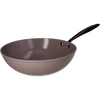
All our wok pans tick these four boxes as standard. You'll find them all together on our induction wok pan page, with the differences by material and colour.
Aluminium or stainless steel: which wok suits you?
With us you choose between two types. Both with a ceramic non-stick coating without PFAS, both suitable for induction.
Aluminium with ceramic non-stick coating
- Light in the hand, handy if you toss a lot
- Heats up fast and responds straight away when you change the setting
- Available in a whole range of colours
Take a look at the ceramic wok pans if you want colour in your kitchen.
Stainless steel with ceramic non-stick coating
- Sturdier and heavier, sits steadily on the hob
- Robust for everyday use
- Sleek polished look from our Honey range
Want more stainless steel next to your wok? Have a look at our stainless steel pans.

Is a 30 cm wok pan big enough?
Looking for a large wok pan for induction? For most kitchens, 30 cm is just right. You can easily stir-fry for two to four people, and the base fits the largest zone on almost any induction hob.
Bigger sounds tempting, but on induction only the base gets hot. A huge wok on a small zone gives you a scorching centre and lukewarm edges. Cooking for a full table? Wok in two rounds. It's better for the bite anyway.
How to heat your wok on induction without wrecking it
This is where it often goes wrong. Putting an empty wok on boost feels bold, but it's the fastest route to a warped base and a coating that gives up.
- Start on medium with a splash of oil in the pan
- After a couple of minutes, move up to a maximum of 80% power
- Leave the boost function alone
- Ready when the oil thins out and shimmers and a piece of onion sizzles straight away
Why not just go full blast? A pan with a ceramic coating conducts heat so well that you don't need that last 20%. Read more in why 80% on induction is the new 100%. And if you want to know what happens when you do it anyway, read how to stop your pan warping on induction.
Wok cooking on induction in 6 steps
Want a method that always works? Here it is.
- Chop everything beforehand into even pieces and keep it next to the hob
- Heat your wok as described above, with a little oil
- Sear your meat, tofu or prawns quickly and hard, then take them out for a moment
- Stir-fry the vegetables in small batches, the firmest first
- Put everything back in the wok
- Pour the sauce down the side and let it reduce briefly
Hear a clear sizzle with every new ingredient? You're on track. Hear a gentle bubbling? There's too much in the pan.
Why your vegetables go watery (and how to stop it)
A watery stir-fry isn't induction's fault. It's down to too much in the pan at once. The temperature drops and your vegetables stew in their own juices.
- Pat washed vegetables properly dry
- Take meat out of the fridge a quarter of an hour beforehand
- Cook in batches instead of all at once
- Keep the wok on the hob: lift it to toss and the induction hob stops heating
Limp is not an option.

That smoky wok flavour: how close can you get on induction?
Let's be honest: the real wok hei from an Asian restaurant comes from an open flame that ignites the vapours above the pan. No induction hob can copy that.
But you can get a long way. The secret is caramelisation, not fire:
- Cook in small batches, so everything really browns
- Let your ingredients sit for a moment now and then before tossing
- Pour soy sauce or oyster sauce down the hot side, so it caramelises instantly
- Finish with a few drops of toasted sesame oil
That's building flavour. Not luck.
Which oil should you use for wok cooking?
Pick an oil with a high smoke point, such as groundnut oil or rice bran oil. A mild olive oil works too. Save extra virgin olive oil for your salad, and leave cooking sprays in the shop: they leave a sticky film on your non-stick coating.
Want to know more? Read which oil, butter or spray really works in your ceramic pan.
Cleaning without the washing-up drama
After all that wok action, you don't want a scrubbing marathon. You don't need one.
- Let your wok cool down first, never hot under the cold tap
- Wash it with warm water, a drop of washing-up liquid and a soft sponge
- Use wooden or silicone utensils, so the coating stays smooth for longest
- Dry it straight away before putting it away
Hand washing is always the best choice. If you do use the dishwasher, skip the eco setting and harsh all-in-one tablets. Find more tips in how to clean ceramic pans.
How long does a wok pan for induction last?
Our wok pans come with a 7-year guarantee on manufacturing and material defects and 2 years on the performance of the ceramic coating. In practice, you'll be cooking with it for much longer. What changes first is the smoothness of the coating with intensive daily use. Heat it gradually and use the right utensils, and it stays in top shape for longest.
And no PFAS in the coating, so you can serve your stir-fry with peace of mind. Curious why that matters? Take a look at our wok pans without PFAS.
Frequently asked questions about wok cooking on induction
What setting should you use to wok on induction?
Start on medium and work up to a maximum of 80% of the power. You don't need more. Best to skip the boost function, as it can warp the base of your pan.
How long should a wok preheat on induction?
About two minutes, with a splash of oil in it. Does the oil shimmer and a piece of onion sizzle straight away? Then you're good to go.
Why does my wok hum or tick on induction?
That's normal. The magnetic field makes the base vibrate slightly, especially on a high setting. A lower setting or a bit more food in the pan usually makes it quieter.
Why has my wok suddenly started sticking?
Usually because of too much heat, an empty pan heated for too long, or a cooking spray that has left a sticky film. Clean the pan thoroughly, heat it gradually from now on and choose an oil with a high smoke point.
Can a wok pan go in the dishwasher?
It can, but hand washing is better for the ceramic coating. If you do use the dishwasher, avoid the eco setting and harsh tablets, and dry the wok straight away.
Ready to wok?
You don't need gas to have fire. The heat isn't in the flame, it's in your pan. Whether you're throwing together a quick weeknight stir-fry or going all out with an Asian night for friends, with the right wok you never do things by halves.
See all our wok pans on our induction wok pan page. Still not sure? You get 60 days to cook with it, so just try it at home on your own hob.
Need other pans for your induction hob too? Browse all our induction pans.
💡 Please note: we love cooking with boldness, but safety always comes first. Read more on our disclaimer page.